
Part 6 of 6 in the MaxisRichards.com Patent Research Series.
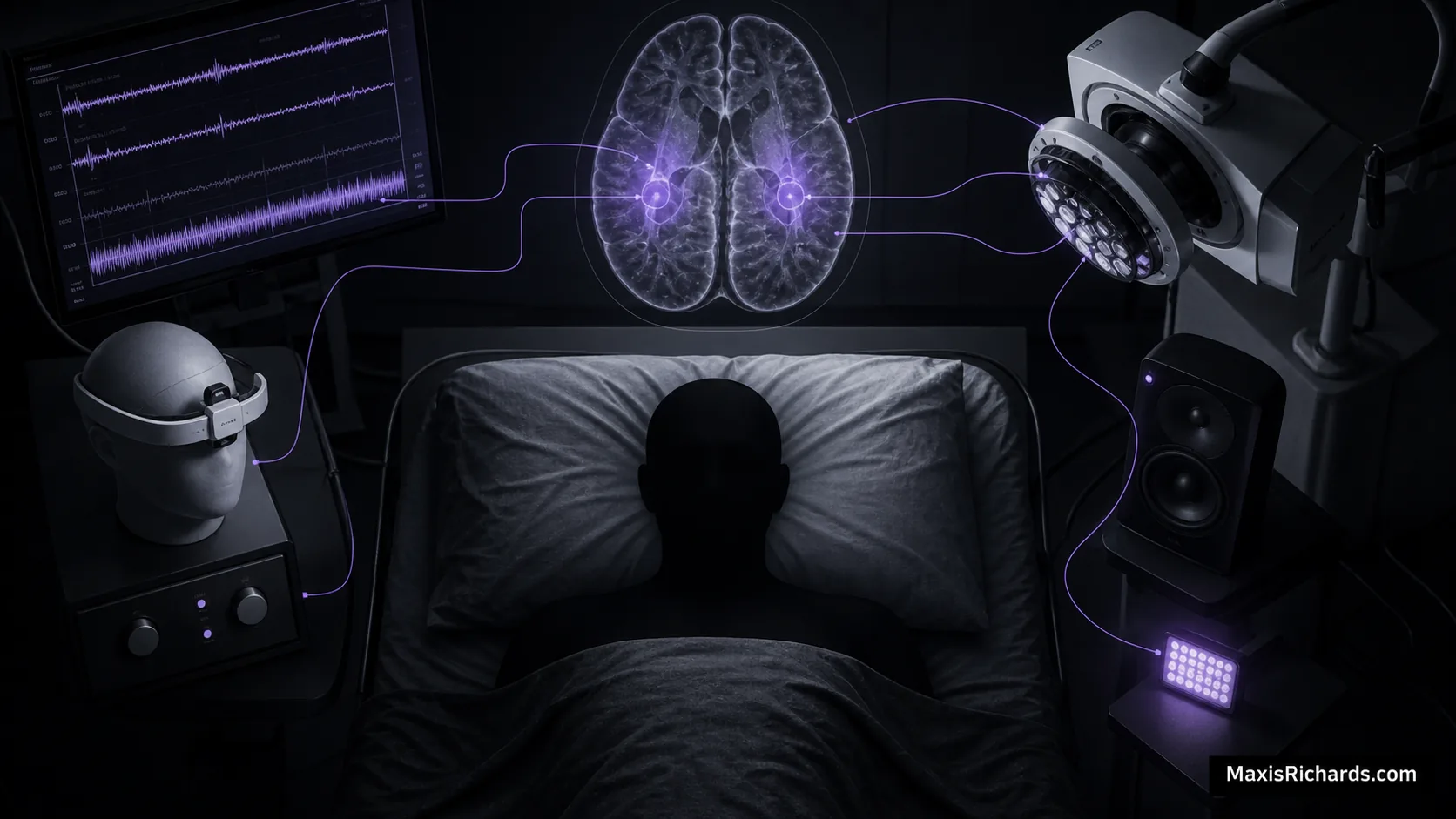
This entry focuses on REM detection, dream cues, altered-consciousness systems, and sleep induction. Wearable dream prompting and RF sleep-induction claims are treated as different technologies.
What a patent establishes: A patent records what an inventor claimed and disclosed. It does not, by itself, prove that every embodiment works as described, that a system was deployed operationally, or that it was used against any specific person. This series separates the patent record from interpretation.
Patent Records

The community has long reported that their sleep is disrupted or that they experience “forced dreams.” Several patents describe systems that detect REM sleep and deliver sensory input to influence dream content—or directly induce sleep using electromagnetic waves.
US10242585B2 – “Systems and methods for delivering sensory input during a dream state” (Imran/Harris)
- Inventors: Mir Imran, Joel M. Harris | Assignee: Incube Laboratories LLC
- Filed: March 14, 2014 | Granted: March 26, 2019
- Summary: Detects neurological activity indicating REM sleep and delivers audio or other sensory input for learning, subconscious messaging, or dream modification.
- TI community relevance: A patent describing REM detection followed by sensory input intended to influence learning or dream content.
- View patent
US5551879A – “Dream state teaching machine” (Raynie et al.)
- Inventors: Arthur D. Raynie, Raul G. Rodriguez, Gary L. Forister, Alexander B. Crawford
- Assignee: Dream Weaver JV | Filed: September 16, 1994 | Granted: September 3, 1996
- Summary: A worn headband detects REM eye movements and plays prerecorded messages through headphones to aid lucid dreaming.
- View patent
US20240307652A1 – “Dream directing system and method for using the same” (Leslie, application)
- Inventor: Kenneth Rajan Leslie | Filed: March 14, 2023
- Summary: Detects REM sleep via smartwatch/smartphone and triggers light, sound, vibration, or other cues to bias dream content.
- View application
US5289438A – “Method and system for altering consciousness” (Gall)
- Inventor: James Gall | Filed: January 14, 1993 | Granted: February 22, 1994
- Summary: Simultaneous audio‑visual stimuli induce altered states of consciousness; uses include sleep‑pattern modification and dream recall.
- View patent
US11241187B2 – (see Section 3) also directly claims sleep induction via RF electromagnetic waves.
Continue the Patent Research Series
← Previous: Subliminal Influence Patents · Series Index
- Voice-to-Skull Patents: Microwave Hearing and Radio-Frequency Auditory Effects
- Remote Neural Monitoring Patents: Brainwave Sensing, Communication, and Inner-Voice Research
- Electromagnetic Neuromodulation Patents: Nervous-System Effects, Sensory Resonance, and RF Systems
- Synthetic Telepathy and Ultrasound Patents: Direct Communication and Noninvasive Neuromodulation
- Subliminal Influence Patents: Silent Messaging and Behavior-Modification Systems
- Dream and Sleep Manipulation Patents: REM Detection, Sensory Input, and Sleep-State Technology
Author’s note: This content presents research, analysis, and opinion about public patent records. It is published for documentation, education, advocacy, and public discussion.
The trail behind this content
- Maxis Richards Archive ↗
- https://patents.google.com/patent/US10242585B2/en ↗
- https://patents.google.com/patent/US5551879A/en ↗
- https://patents.google.com/patent/US20240307652A1/en ↗
- https://patents.google.com/patent/US5289438A/en ↗
- USPTO Patent Public Search ↗
MaxisRichards.com is my living archive of testimony, research, public records, visual intelligence, and the continuing Project Puppet record. I preserve this work so the history remains accessible, the patterns can be studied, and the voices of Targeted Individuals are not erased.
Continue the Project Puppet record
Author’s Note: This content presents the personal experiences, research, analysis, conclusions, and opinions of Maxis Richards. It reflects his understanding of Project Puppet and the public records, testimony, and sources cited. It is published for documentation, education, advocacy, and public discussion.