
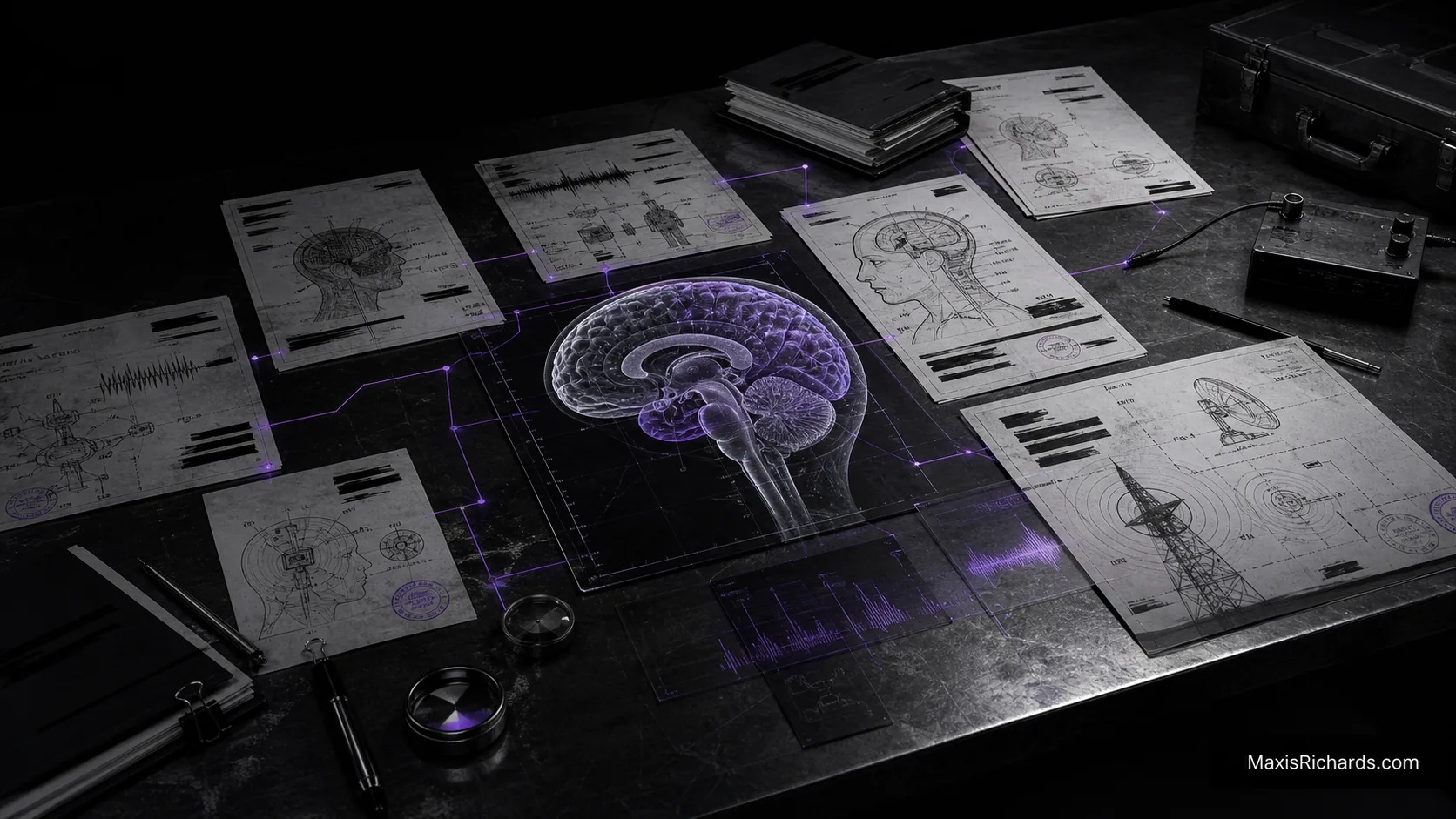
The master index for the MaxisRichards.com Patent Research Series.
This series is written for the Targeted Individual community and for anyone researching public records related to Voice-to-Skull (V2K), remote neural monitoring, electromagnetic nervous-system effects, synthetic telepathy, subliminal influence, and dream or sleep-state technology.
The original Patent Trail article placed every subject on one very long page. This corrective edition separates the material into six focused entries so each patent can be read in context, checked against its source, and cited without unrelated sections getting in the way.
What a patent establishes: A patent records what an inventor claimed and disclosed. It does not, by itself, prove that every embodiment works as described, that a system was deployed operationally, or that it was used against any specific person. This series separates the patent record from interpretation.
Choose a Research Path
1. Voice-to-Skull Patents: Microwave Hearing and Radio-Frequency Auditory Effects
Covers foundational microwave-hearing records, including the Brunkan and Stocklin patents and the U.S. Air Force patents for intelligible radio-frequency hearing. It also identifies an abandoned application that explicitly uses the terms “Voice to Skull” and “Remote Neural Monitoring.”
2. Remote Neural Monitoring Patents: Brainwave Sensing, Communication, and Inner-Voice Research
Separates contactless claims from systems that require scalp electrodes, body-worn sensors, ear-worn devices, or trained user-specific signal mapping. This distinction is essential when evaluating what a patent actually discloses.
3. Electromagnetic Neuromodulation Patents: Nervous-System Effects, Sensory Resonance, and RF Systems
Collects the Hendricus Loos sensory-resonance patents and other electric, magnetic, thermal, and radio-frequency systems. The guide records claimed effects while distinguishing patent language from proof of use against a specific person.
Open the electromagnetic patent guide →
4. Synthetic Telepathy and Ultrasound Patents: Direct Communication and Noninvasive Neuromodulation
Reviews transcranial ultrasound, direct-communication claims, cognitive effects, and noninvasive brain-computer interface research. The entry explains where “synthetic telepathy” is a useful research term and where it can overstate the hardware described.
Open the synthetic telepathy and ultrasound guide →
5. Subliminal Influence Patents: Silent Messaging and Behavior-Modification Systems
Organizes silent audio, visual subliminal messaging, post-hypnotic triggering, and behavior-modification systems by their actual mechanisms instead of treating them as one technology.
Open the subliminal influence guide →
6. Dream and Sleep Manipulation Patents: REM Detection, Sensory Input, and Sleep-State Technology
Covers REM detection, dream-directed sensory input, lucid-dream prompting, altered-consciousness systems, and a separate RF sleep-induction patent.
Open the dream and sleep patent guide →
How to Read This Series
Each entry follows the same research standard:
- Record the patent number and exact title.
- Identify the inventor, assignee, filing date, grant or publication date, and legal status when relevant.
- Summarize the disclosed mechanism without silently expanding the claim.
- Separate granted patents from published or abandoned applications.
- Explain why the record matters to Targeted Individual research.
- State the boundary between documented capability, proposed capability, and alleged operational use.
- Link directly to the patent record so readers can inspect the source.
This structure corrects the spacing and attribution problems in the earlier page and makes the research easier to audit.
Government Research Context
Patents are only one part of the public record. DARPA’s completed N³ program, for example, pursued high-performance, bidirectional brain-machine interfaces that would not require surgical implantation. DARPA described an objective of reading from and writing to neural tissue using noninvasive or minutely invasive approaches.
Read DARPA’s official N³ program summary →
That official program description establishes government interest in advanced nonsurgical neural interfaces. It does not establish that an operational system was secretly used against a particular person. The same evidence standard applies throughout this series.
What the Patent Record Shows
Read together, the records document sustained work across several distinct technical areas:
- Radio-frequency auditory effects and intelligible subjective sound.
- Brainwave sensing, signal classification, and brain-computer communication.
- Electric, magnetic, thermal, radio-frequency, and ultrasound neuromodulation.
- Silent or subliminal audio and visual presentation systems.
- REM detection, dream cueing, altered-state systems, and sleep induction.
Those categories should not be collapsed into one machine. The purpose of this series is to preserve the public record, identify real technical overlap, and make the limits of each source visible.
The Central Question
Public patents and official research programs show that governments, universities, defense contractors, and private inventors have pursued technologies that interact with hearing, brain activity, behavior, sensation, and sleep. The unresolved questions concern capability outside the disclosed embodiments, operational deployment, consent, oversight, and accountability.
For Targeted Individuals, accurate records matter. Strong documentation is more persuasive when patent claims, demonstrated systems, personal testimony, and allegations are clearly labeled instead of blended together.
Patent Research Series
- Voice-to-Skull Patents: Microwave Hearing and Radio-Frequency Auditory Effects
- Remote Neural Monitoring Patents: Brainwave Sensing, Communication, and Inner-Voice Research
- Electromagnetic Neuromodulation Patents: Nervous-System Effects, Sensory Resonance, and RF Systems
- Synthetic Telepathy and Ultrasound Patents: Direct Communication and Noninvasive Neuromodulation
- Subliminal Influence Patents: Silent Messaging and Behavior-Modification Systems
- Dream and Sleep Manipulation Patents: REM Detection, Sensory Input, and Sleep-State Technology
Author’s note: This content presents the author’s research, analysis, conclusions, and opinions about public records and reported experiences. It is published for documentation, education, advocacy, and public discussion; it is not presented as a judicial finding or as independently verified proof that any specific technology was used against any specific person.
The trail behind this content
- Maxis Richards Archive ↗
- Google Patents Public Database ↗
- USPTO Patent Public Search ↗
- DARPA N3: Next-Generation Nonsurgical Neurotechnology ↗
MaxisRichards.com is my living archive of testimony, research, public records, visual intelligence, and the continuing Project Puppet record. I preserve this work so the history remains accessible, the patterns can be studied, and the voices of Targeted Individuals are not erased.
Continue the Project Puppet record
Author’s Note: This content presents the personal experiences, research, analysis, conclusions, and opinions of Maxis Richards. It reflects his understanding of Project Puppet and the public records, testimony, and sources cited. It is published for documentation, education, advocacy, and public discussion.